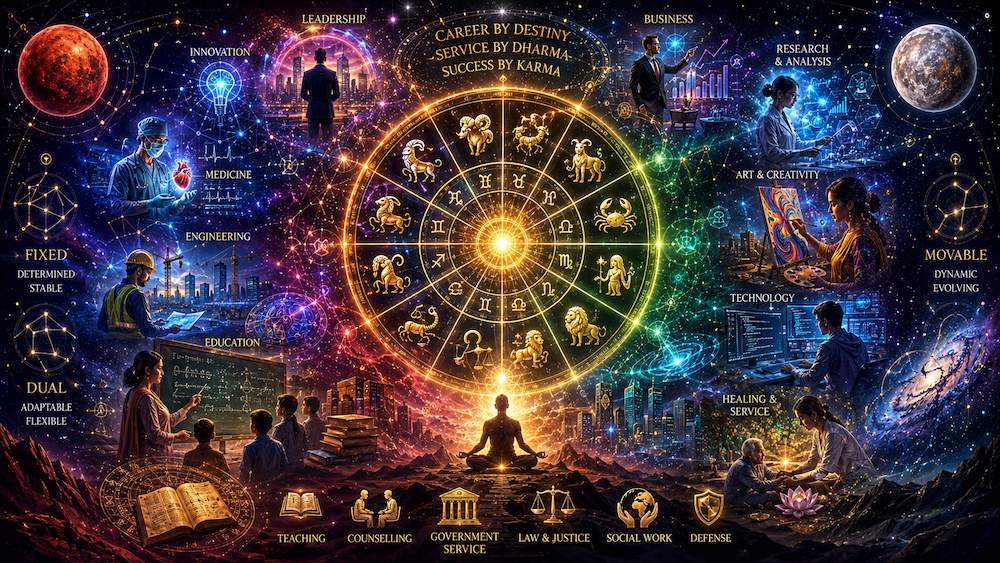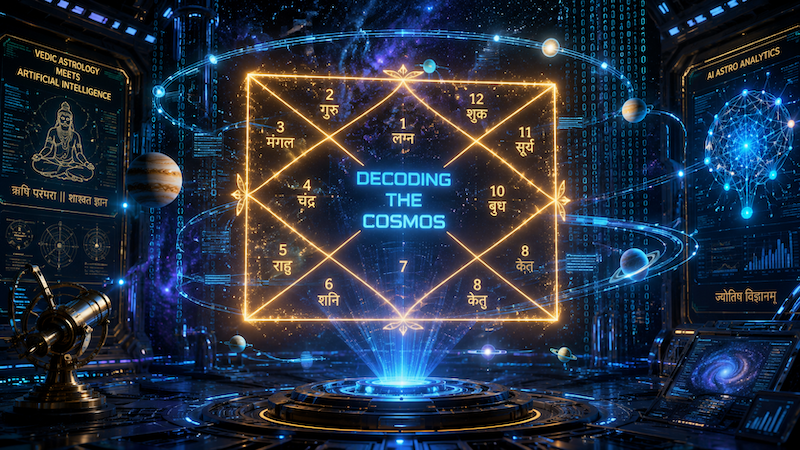
The Ultimate Guide to Decoding a Vedic Birth Chart
Moving Beyond “Bookish” Astrology If you have ever tried to learn Vedic Astrology, you know the feeling of overwhelm. You memorize thousands of combinations from books—“If Mercury is four houses from Saturn, this happens”—only to look at a real birth chart and draw a complete blank. The truth is, astrology cannot be learned by rote memorization. It requires a clear mental framework, an understanding of core planetary principles, and a strict sequence of analysis. In this comprehensive guide, we will synthesize the deepest layers of chart analysis. We will move beyond “bookish” predictions, understand the true architecture of a horoscope, and outline a definitive 8-Step Algorithm to decode any birth chart accurately. Part 1: The Mental Framework – 6 Layers of Prediction Before jumping into complex yogas or Dashas, you must train your mind to build a prediction layer by layer. Do not skip steps. Part 2: The Architecture of a Chart To judge a chart, you must view it as an ecosystem of Pillars, Supports, and Frictions. 1. The Pillars (Kendras: 1, 4, 7, 10) The Kendras are the Vishnu Sthans—the foundational pillars that hold up a person’s life. The Rule of Malefics in Kendras: If you place a house as the “Lagna” (e.g., treating the 11th house of income as the 1st), check its Kendras. If only malefic planets sit in the Kendras, success in that area will not come easily. You will have to fight and work incredibly hard for it. Benefics here make the journey smooth. 2. The Support System (Trines: 1, 5, 9) The Trines are the Lakshmi Sthans—the blessings, grace, and support systems. 3. The Struggle (Dusthanas: 6, 8, 12) These are the houses of friction. The “6/8/12 From Any Point” Concept This is a master key of predictive astrology: A planet placed 6th, 8th, or 12th from ANY reference point damages the significations of that point. Part 3: How to Judge Any Specific House When analyzing a specific topic (like wealth, marriage, or career), apply these four rules to the relevant house: Part 4: The 8-Step Master Algorithm for Chart Analysis Do not jump around the chart randomly. Follow this strict sequence to synthesize your reading. Step 1: Analyze the Lagna & Lagna Lord (The Vessel) Before looking at wealth or career, ask: Is the physical vessel strong enough to handle life? Step 2: Analyze the Moon & Its Dispositor (Mental Satisfaction) A person can have millions in the bank but be deeply miserable if the Moon is afflicted. Step 3: Analyze the Relevant House and House Lord Identify the house related to the client’s question (e.g., 7th for marriage). Step 4: Analyze the Relevant Karaka (Significator Planet) Every area of life has a natural planetary CEO. For marriage, it is Venus (and Jupiter for women). For career, it is Saturn/Sun. Step 5: Analyze the Relevant Divisional Chart (Varga) Step 6: Look for Yogas (Planetary Combinations) Are there Raj Yogas, Dhana Yogas, or Vipreet Raj Yogas? Step 7: Analyze the Dashas (The Timing) A chart shows the promise of an event, but the Dasha shows the timing. Step 8: Analyze the Transits (The Final Trigger) Only if the Dasha suite promises an event do we look at transits to pinpoint the exact time. For an event to fructify, look for a combination of these four planets transiting over the relevant house in D1 and the specific Divisional Chart: The Golden Rule of Timing (Double Transit): Look for the combined transit influence of Saturn (the Karma Karaka) and Jupiter (the Dharma Karaka). When both Saturn and Jupiter simultaneously aspect or transit over a specific house or its lord (in D1 and the relevant Varga), the likelihood of that house’s event fructifying is incredibly high. Conclusion Astrology is not a parlor trick of memorized formulas. It is the deep, spiritual science of synthesizing a human life. By moving away from “bookish” combinations, respecting the supremacy of the Lagna and the Moon, and following a strict analytical algorithm, you can unlock profound, accurate, and life-changing insights within any birth chart.